Showing posts with label Anne Mahoney. Show all posts

Friday, October 29, 2010

Steve Jobs: The ultimate IMCer?

(A formal invitation for Steve Jobs to guest lecture at Medill IMC)

By Anne Mahoney

In a recent article featuring an interview with Jobs’ old boss at Apple, John Sculley, details about the mythical man had me reeling with pride. “He’s a total IMCer!” I thought as I read about Jobs’ focus on user experience before market share. It illuminated a vast difference between Apple and Japanese companies – and also IMC students and MBAs.

The article was especially timely as we had the opportunity last week to hear Jose Costa speak on the difference between IMC and MBA students. Costa is a Medill IMC grad and currently finishing up an MBA at the University of Chicago Booth School of Business. Among the more conspicuous degree comparisons, the one that had us students applauding was his slide featuring IMC as a Mac and MBA as a PC. Steve, did you hear that?

As IMC students, we are constantly urged to consider the question: “What business are you in?” Jobs was the only person, back in the 80s, to view the computer as a product for personal use. Guess he nailed that one.

We also learn that consumer data is extremely important, but the frustrating part about consumers is that they can rarely articulate exactly what it is they want or need. It is up to companies and mostly marketers to anticipate that need, and to create a product or messaging to satiate it. Jobs did exactly this, too, when he visualized the Macintosh, which was far outside the realm of what calculator users thought they needed.

The article highlights how the success of Apple is most definitely a result of Jobs’ emphasis on product design. Although Medill incorporates a rich and varied amount of elements crucial for integrated marketing into the program, Jobs also makes a great case for why design should be a topic more relevant at Medill. If we as marketers are able to influence the core of the user experience, what a person sees and feels, that will make us more successful in all other communication surrounding it.

So Steve, if you’re not too busy, feel free to stop by Evanston and teach us a thing or two about this design thing you’ve changed the world with. Lunch is on us.

***

Anne Mahoney is the Social Media Director at Vitamin IMC and a student in the Integrated Marketing Communications graduate program at Northwestern University's Medill School. She can be reached at AnneMahoney2010@u.northwestern.edu.

Wednesday, July 7, 2010

Medill IMC students get real with summer projects

Wondering where we've been the past month? Busy, to say the least, and here's why.

By Anne Mahoney

This summer, students from Medill IMC’s 2010 class are working on group projects and individual residencies for a number of well-regarded client sponsor projects. The entire quarter is spent on real world application of the classroom knowledge gained in quarters one through three. We are tasked with harnessing those qualitative and quantitative skills to demonstrate what IMC whizzes we have become through tackling a real marketing challenge.

Each project is different, depending on client needs, so students doing group projects bid for the team that would best compliment their strengths and career ambitions. Individual residencies go through a typical interviewing process and spend the summer on-site with their clients. At the end of the summer, each team presents its findings, solution, recommendations, model or other specified outcome to the sounds of raucous applause and implementation by the sponsor company.

This summer, we’re grateful to have a fantastic roster of clients to work with: Best Buy, Cricket Communications (Leap Wireless), Discover Card, Draftfcb and Kraft (in Paris and Shanghai), Fannie May Chocolates, FedEx, OnStar, Procter & Gamble, T. Rowe Price, Shiseido, Iris and ReachMD. Each team works directly with the company and is also assigned a faculty member as advisor.

A number of students are also working full-time in individual residencies. Two great examples working in the Chicago area are Josh Friedman and Sara Smith. Josh is in product management at Motorola, where he is creating a rich SWOT analysis for Motorola's social strategy for mobile phones in the development pipeline through 2012. Sara is in account planning at advertising agency Euro RSCG, unearthing consumer insights used to guide integrated ad campaigns.

It’s now “go time” in full swing, and we’re excited to finally be putting our hard work from the classroom into practice.

Best of luck to everyone!

***

Anne Mahoney is Social Media Director of Vitamin IMC and a student in the Master’s in Integrated Marketing Communications program at Northwestern University’s Medill School. She’s doing her group project on consumer insights with Iris. You can find her tweeting at http://twitter.com/agmahoney.

Wednesday, May 19, 2010

Building a personal brand: Vitamin IMC social media panel offers job search tips

By Ashley Graves and Anne Mahoney

Tweet. Blog. Build an online personal brand. Most professionals seeking work in the digital media landscape have often heard that advice.

As many things are, it’s often easier said than done.

What should I tweet or blog about? How should I shine myself up online for potential employers? What’s the one mistake I shouldn’t make (and have I already made it?!?). All are questions that many marketing students and professionals face in searching for a job.

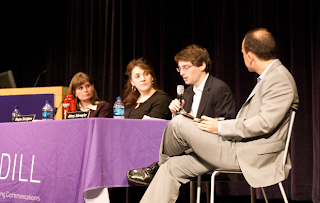
On Monday, Vitamin IMC hosted its first ever social media panel to discuss the essentials and benefits of using social media to connect to a career in communications. Lucky for our audience, we were bestowed with expert advice from some seasoned pros.

We were fortunate to have Blagica Bottigliero, Emmy-winning blogger and member of the Edelman Digital team, Johnny Schroepfer, Medill IMC student, and Gini Dietrich, founder and CEO of Arment Dietrich, share insights and tips on how to use social media tools to build a personal brand and find a killer job.


“What social media has done is completely flatten out the globe,” said Dietrich, referring to the ability to talk to anyone on Twitter, including CEOs and popular industry figures.

A key point in using social media for the job search is that you get out of it what you put into it. Bottigliero advised that job seekers should put twice as much time into their search as they do studying or with other media such as TV or texting.

Job seekers should also be wary of over-spamming new online contacts or being completely self-promotional.

“The last thing they want to know is all about you,” said Schropefer. “Its about communication and interaction. It’s two ways.”

Key Takeaways…

On building a personal brand:

  • Own your own domain name and use your actual name to come up more often in searches.
  • Clean up any online information about you that doesn’t look professional (ahem, Facebook party photos from college). And yes, recruiters actually look for unprofessional antics and flag those applicants.
  • Go to namechk.com. This site allows you to see where your name is registered on any social media site, and where it isn’t. Make sure you own your name on all relevant sites.

On Twitter:

  • Keep interactions relevant. Don’t clog someone’s stream with a surplus of @replies.
  • Drive people to your LinkedIn page or website. Twitter isn’t the ultimate answer to connect with people in your job search.

On Blogging:

  • Write about what you’re passionate about – people find you valuable if you have a niche and offer information generalists can’t.
  • Try not to be negative on your blog; nobody wants to hire someone who complains.

If there’s one thing our audience learned, it was to start the digital conversation now and to make ourselves known to potential employers in an authentic way. Relationships rule. Take the time to research, relate and impress.

As Gini Dietrich told us, “If I receive a resume from someone who has not taken time to connect with my company on social media, I won’t even look at it.”

How’s that for inspiration?

Monday, May 3, 2010

The Pepsi Refresh Project: Inside the Secret Formula

A Conversation with David Dreyer of TBWA\CHIAT\DAY

In January, Vitamin IMC ran a post about Pepsi’s decision to spend millions on a program called the Pepsi Refresh Project instead of investing in its traditional Super Bowl advertising spots. Little did we know that the concept was developed by a team from TBWA\CHIAT\DAY Los Angeles that included Medill IMC alum David Dreyer. Vitamin IMC Social Media Director Anne Mahoney was fortunate enough to have a conversation with David on the strategy and IMC elements behind the successful project.

On Strategy

“Pepsi wasn’t going to be the first to do philanthropic work or social media, and didn’t want to be a ‘me too’,” said Dreyer.

So how did TBWA\CHIAT\DAY propose capturing the essence of the Pepsi brand in an authentic way that resonated with consumers?

“Pepsi has always been at its best as a catalyst for change. In the Great Depression, it doubled the amount of ounces for the same cost. During World War II, it adopted its patriotic red, white and blue colors. It was always leading culture.”

The Pepsi Refresh Project was an idea formed from consumer insights. The Pepsi Refresh Project gives financial grants to anyone’s causes or ideas that gain the highest number of votes. With enthusiastic support from Pepsi CEO Indra Nooyi and company bottlers, the TBWA\CHIAT\DAY developed its rollout plan to the public.

“It was very deliberate – a marathon and not a sprint,” said Dreyer. “Refresh was launched in 2009 when we talked about it [to the public], and in 2010 we acted on it.”

Grant submissions began online in January 2010, with a cap of 1,000 on a first-come, first-serve basis each month. To give an idea of how popular the Pepsi Refresh Project has become, that 1,000-submission quota was reached in 30 minutes when opened for April.

On Engagement

The Refresh Project gives Pepsi the extra marketing power Super Bowl commercials fall short on – customer engagement. Where companies pay millions for celebrities to endorse their brands, Pepsi now has celebrities coming to them wishing to participate. Rihanna, Jenny McCarthy, Eva Longoria and Mariska Hargitay are just a few who have submitted grant ideas.

A great example of how the Refresh Project has helped its consumers is the case of Johnny Greenshield, a 14-year-old who won $25,000 with his homemade video of a new aerodynamic hood invention for buses.

On Demographics

When I think Pepsi marketing, I think of Gen Y as the ideal target audience. David had an intriguing response to that assumption.

“Pepsi symbolized youth, but some of its most loyal consumers are boomers. It needed an idea that bridged gap between millennials and boomers. Both groups are powerful agents of change, but because of psychographics rather than demographics.”

Do you think that boomers are too far outside of the internet age to participate?

“The majority of ideas are submitted by boomers, and they are the fastest growing demographic on Facebook,” Dreyer continued. “They have time, are computer-savvy, and it’s a way for them to keep in contact with friends and family.”

The Pepsi Refresh Project is an integrated marketing campaign that we’re continuing to keep an eye on. I’d like to give my personal thanks to David Dreyer for sharing his insights with Vitamin IMC.

--Anne Mahoney

***

Anne Mahoney is the Social Media Director of Vitamin IMC and a student in the Masters in Integrated Marketing Communications program at Northwestern University’s Medill School. In the 90s she tried to win Deion Sanders gear through the Pepsi Stuff promotion. She can be reached at AnneMahoney2010@u.northwestern.edu.

Thursday, April 1, 2010

Walmart & the stickiness of customer loyalty

By Anne Mahoney

Walmart’s pricing strategy of everyday low, low, sometimes unbelievably low prices has earned it high points in customer loyalty, according to a new survey. But does this loyalty translate into true affection, or will the retailer lose its golden product retrievers to a new master once pricing is no longer the dominant differentiator?

The very public price war between Walmart and Amazon.com at the end of 2009 was a prime demonstration of the heavyweight’s affect on other retailers. It also demonstrated the tenacity of the “little guys” to match pricing that would barely achieve above-margin revenue. Target entered the ring after Amazon, each squaring off against Walmart by dramatically dropping prices.

What’s the potentially larger problem for all retailers involved? Setting a standard for customer expectations. Walmart’s customers may not be actually loyal to Walmart, the brand. They are loyal to the prices on Walmart’s tags. And now with online shopping price comparison sites and savvier retailer incentive programs, Walmart may need to be more than just the cheapest lemonade stand on the block.

Several strategies for retailers preparing to exit the recession era and compete outside of pricing were offered by DIRECT Magazine. It recommend competing on the best landscape suited to the brand, targeted promotions, strategic use of information and selective pricing.

To add to those recommendations are a few more, compliments of the Medill IMC classroom:

  • Personalized Communications & Incentives: The success of grocery retailer Tesco by marketing agent dunnhumby is a much-discussed case at Medill. Retailers who know how to leverage customer data and provide personal attention in the form of promotional offers have the upper hand in achieving real loyalty.

  • Experiential Shopping: Quick – what do you think of when you read “Target”? How about “Best Buy”? Now think “Walmart.” It is likely you thought of specific experiences, imagery, products or customer service for the first two. Did you think about cheap prices for Walmart? That’s where brand equity comes in.

  • Exclusivity: The economic situation has turned retail into a flea market. Everyone is shopping around for the best price. If retailers can’t compete on price, they can compete with superior product selection and avoidance of substitutability.

***

Anne Mahoney is Social Media Director at Vitamin IMC and a student in the Masters in Integrated Marketing Communications program at Northwestern University's Medill School. She is smitten by Target’s advertising, to give full disclosure to this article. She can be reached at annemahoney2010@u.northwestern.edu.

Wednesday, February 17, 2010

Data Mining vs. Science: How OkCupid translates data into dates

By Anne Mahoney

If you’ve ever marketed yourself online in the romance department, you likely have painstakingly analyzed every part of your profile. Is the photo attractive? Do I say the right things about myself? How should I word my first email to another enticing product in the dating aisle?

An article in the New York Times looks into how OkCupid, an online dating site, shares user data with its registered love-seekers to provide advice on how to develop and market their personal brands. To find the data, it analyzed 7,000 user profiles, noting photos, number of responses and content of those responses. One useful finding was that being “fascinating” or “cool” is more important than the initial physical attraction factor. For instance, OkCupid says a woman using a photo portraying her playing an instrument or on an exotic beach receives more responses than focusing on physical assets.

If true, this certainly is valuable information for site-users. The study has, however, strictly focused on pure numbers through data mining. To gain additional insights, I sought out the opinion of the foremost expert I know in statistical data analytics: Medill IMC professor Edward Malthouse. Professor Malthouse brought up the scientific question still at large for OkCupid: Why do these tactics work? He thinks marketing can help to explain.

“Some physical beauty is a point of parity,” he said. “Differentiators will make you stand out, at least among a segment that values such activities. So, marketing theory predicts that those who are differentiated will be more successful.”

That is the scientific way to view the findings of OkCupid’s study. It hypothesized that differentiators would increase or decrease response rates, which the study confirmed. Yet there are other variables that have not been taken into account. Malthouse points out an example as the experiences of the customer, or date-seeker browsing through profiles. These experiences are not directly focused on the “product,” or person trying to find a date. If each individual created a first-impression experience for the type of person they are trying to attract – the “targeted consumer” – Malthouse theorizes it would have an even stronger effect.

Boiling down an intimate subject with numerous and oftentimes-mysterious factors, such as dating, into pure numbers surely has its challenges. Do you think there’s truth to the OkCupid study? How can marketers benefit from activating these types of analytical tactics?

***

Anne Mahoney is the Social Media Director at Vitamin IMC and a student in the Masters in Integrated Marketing Communications program at Northwestern University's Medill School. She can be reached at annemahoney2010@u.northwestern.edu


Monday, January 11, 2010

Pepsi’s Super Bold Cause Marketing Move

It’s tough to imagine the Super Bowl without the Pepsi ads. Full of pop culture, sex appeal and charm, the spendy spots are being benched this year in favor of a new marketing plan. The soda giant is instead re-funneling $20 million of its advertising dollars to the “Pepsi Refresh Project,” awarding grant money to community projects selected by its consumers. The Wall Street Journal offers a comprehensive piece on the decision, but here’s my perspective as an IMC student, armchair advertising critic and Pepsi drinker.

In its current stage – before consumer engagement, attitudes and profit margins are calculated – Pepsi’s strategy is downright applaudable. It likely wouldn’t have had the same effect just two years ago. Back then, we Americans basked in frivolity. Paying $2.7 million for a 30 second first quarter belly laugh was pure bragging rights for many a company. Sure, Pepsi also was likely backed into spending binges by direct pressure from Coca-Cola. To remove themselves from competition on the biggest advertising platform in the world must have more than a few Pepsi executives biting their nails right now. But my prediction is this: it will be worth it, and here’s why:

Word of Mouth. People will talk about the Pepsi Refresh Project because it’s unconventional, risky and doing some good. If it’s possible to change attitudes, this program has more potential than a short-lived advertisement. Remember Mister Splashy Pants?

Social Media. There’s potential for Pepsi to have a bonanza here. Cause marketing works when people are given the power of participatory influence. Viral engagement will lead to an “everybody wins” scenario, including consumers and the communities being served. Oh, and more brand equity isn’t bad, either.

Legacy. If this concept is ultimately profitable, it will not only be a success story, but one exemplifying a true change in consumer behavior. Although copycats will follow, I think Pepsi will be preserved as a heartfelt pioneer because of the level of risk taken on with this program.

So Pepsi, good luck to you. The bubbly Super Bowl ads will be missed, but the Refresh Project is definitely going to be fun to watch.

--Anne Mahoney

***

Anne Mahoney is the Social Media Director of Vitamin IMC and a student in the Masters in Integrated Marketing Communications program at Northwestern University’s Medill School. She is hoping to watch the Vikings take the cake at the Super Bowl this year. She can be reached at AnneMahoney2010@u.northwestern.edu.