Wednesday, May 26, 2010

IMC and social media: A match made in marketing heaven

By Daniel Hindin

If there wasn’t already enough motivation for marketers to hop on the IMC bandwagon, the explosion of social media over the last several years has brought IMC to the forefront of the marketing conversation once again.

I was recently interviewed for an article about Vitamin IMC that has since been published on the Medill website. One of the questions was: “How do you see social media fitting in with IMC?” My answer didn’t make it into the article, but I think it’s an important point, so I’ve decided to expand upon it here.

At its most basic level, IMC is about customer-centricity. A common description of IMC is data-driven marketing. While this is true, the term can sometimes come across as impersonal when you start thinking about all the numbers, formulas, data schemes and information that lead us to our marketing strategies.

But all of these techniques are aimed at one thing: a deeper understanding of the consumer. The further an IMCer can escape the generalities of a mass audience and focus on the individual human being making specific choices for themselves and their family, the better he or she can do their job.

Social media has given tremendous power to the individual consumer. The concept of brand has never been whatever the marketer tells the consumer it is. The brand has always been the idea of that brand that the consumer holds in their mind. And that can be different things to different people. Consumers have always had these ideas, but until recently, we as marketers rarely heard from them.

With the advent of social media, consumers can (and do) tell us (and anyone else who will listen) what they think of our brands whenever they feel like it. Some of these thoughts may be positive, and some may be negative.

Whatever the case may be, it’s real live communication. This not only gives us a greater understanding of our brand, but it also gives us an opportunity to respond individually to our consumers’ concerns. If they’re enjoying the brand experience, we can provide them with ways to interact with it on a deeper level. If they’re not enjoying it, we can attempt to understand the disconnect and perhaps bridge the gap.

Either way, a two-way conversation has been established. The pinnacle of a brand experience in the mind of an IMCer is for the consumer to establish a relationship with the brand. Relationships are difficult to form without two-way communication. This is the gift that social media has given to IMC.

***

Daniel Hindin is Managing Director of Vitamin IMC and a student in the Master’s in Integrated Marketing Communications program at Northwestern University’s Medill School. He’s also a social media addict. You can find him tweeting at http://twitter.com/danielhindin.

Thursday, May 20, 2010

A 30-second spot, in 30 seconds or less

By Megan O'Malley

A new ad creation interface from Visible World is breathing new life into the good ol’ 30-second spot.

Not only can clients use the resource to create ads from a selection of scenes and content in a matter of seconds, they can also instantly adjust the advertisement to fit each select individual, demographic or geographic target of television viewers.

TV advertising traditionally meant targeting audiences by assuming groups of similar consumers watched certain types of programming. With new ad customization tools, companies can adjust ads based even on live programming events.

Marketing implications? Television can now be used to target segments just like direct mail.

Take Wendy’s, which surprised viewers of an NFL football game by featuring animated raccoons whose dialogue mirrored events in the game right before commercial break.

Subaru is also taking advantage of the condition-based advertising by setting ads for vehicles in weather conditions that mirror the weather of the day in certain regions.

Customized TV advertising generation could reinvent media placement. TV as an advertising channel has drawn recent skepticism from marketers caught on a digital buzz. However, TV remains the highest used media in America by minutes used per day and television advertising still makes up a vast majority of most marketing budgets.

Jerry Dow, Medill IMC alum and Chief Marketing and Sales Officer of Suddenlink, offered insight on the importance of understanding the new with the old.

“Students with an understanding of targeting, segmentation and integration of new and old tools are going to be infinitely more valuable to take advantage of today’s customization trend. IMC students are especially needed to help those stuck in the traditional ways to understand this shift in television advertising,” he said.

The automation of television advertising presents challenges to the traditional creative process in that it requires storylines that are adaptable to varied target audiences. Although quick customization tools are no substitute for the creation of exceptional ideas and creative content, they do serve as powerful tools for creating targeted ads on the fly. Such tools allow creative marketers to quickly speak in a more engaging way to each and every consumer.

***

Megan O’Malley is a graduate student in Integrated Marketing Communications at Northwestern University's Medill School. She misses the good ol' days of Saved By the Bell and Daria on television. She can reached at MeganOMalley2010@u.northwestern.edu.

Wednesday, May 19, 2010

Building a personal brand: Vitamin IMC social media panel offers job search tips

By Ashley Graves and Anne Mahoney

Tweet. Blog. Build an online personal brand. Most professionals seeking work in the digital media landscape have often heard that advice.

As many things are, it’s often easier said than done.

What should I tweet or blog about? How should I shine myself up online for potential employers? What’s the one mistake I shouldn’t make (and have I already made it?!?). All are questions that many marketing students and professionals face in searching for a job.

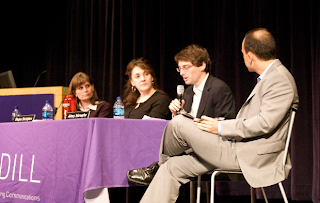
On Monday, Vitamin IMC hosted its first ever social media panel to discuss the essentials and benefits of using social media to connect to a career in communications. Lucky for our audience, we were bestowed with expert advice from some seasoned pros.

We were fortunate to have Blagica Bottigliero, Emmy-winning blogger and member of the Edelman Digital team, Johnny Schroepfer, Medill IMC student, and Gini Dietrich, founder and CEO of Arment Dietrich, share insights and tips on how to use social media tools to build a personal brand and find a killer job.


“What social media has done is completely flatten out the globe,” said Dietrich, referring to the ability to talk to anyone on Twitter, including CEOs and popular industry figures.

A key point in using social media for the job search is that you get out of it what you put into it. Bottigliero advised that job seekers should put twice as much time into their search as they do studying or with other media such as TV or texting.

Job seekers should also be wary of over-spamming new online contacts or being completely self-promotional.

“The last thing they want to know is all about you,” said Schropefer. “Its about communication and interaction. It’s two ways.”

Key Takeaways…

On building a personal brand:

  • Own your own domain name and use your actual name to come up more often in searches.
  • Clean up any online information about you that doesn’t look professional (ahem, Facebook party photos from college). And yes, recruiters actually look for unprofessional antics and flag those applicants.
  • Go to namechk.com. This site allows you to see where your name is registered on any social media site, and where it isn’t. Make sure you own your name on all relevant sites.

On Twitter:

  • Keep interactions relevant. Don’t clog someone’s stream with a surplus of @replies.
  • Drive people to your LinkedIn page or website. Twitter isn’t the ultimate answer to connect with people in your job search.

On Blogging:

  • Write about what you’re passionate about – people find you valuable if you have a niche and offer information generalists can’t.
  • Try not to be negative on your blog; nobody wants to hire someone who complains.

If there’s one thing our audience learned, it was to start the digital conversation now and to make ourselves known to potential employers in an authentic way. Relationships rule. Take the time to research, relate and impress.

As Gini Dietrich told us, “If I receive a resume from someone who has not taken time to connect with my company on social media, I won’t even look at it.”

How’s that for inspiration?

Friday, May 7, 2010

Vitamin IMC Panel: Connecting to Your Career with Social Media

Vitamin IMC is pleased to announce our first panel event on Monday, May 17th at 3 p.m. featuring a number of distinguished speakers and topics to fuel your job search!

The goal of this panel is to give you insight on how to utilize social media networks in connecting with job prospects through building relationships online. You will also hear about how those skills are valuable as a new hire in today’s communications work environment.

What: Vitamin IMC Social Media Panel


When: Monday, May 17th, 3:00 - 4:30 p.m.


Where: McCormick Tribune Center Forum, Medill School of Journalism, Northwestern University 


Moderator:
Dan Gruber, Assistant Professor in the Medill IMC Program & Kellogg School of Management


Panelists:
Gini Dietrich, Founder and CEO of Arment Dietrich and www.SpinSucks.com

Blagica Bottigliero, Emmy-winning blogger and member of the Edelman Digital team

Johnny Schroepfer, Medill IMC student & resident social media specialist

Allan Schoenberg, Director of Corporate Communications for CME Group

Can't wait to see you there!

Monday, May 3, 2010

The Pepsi Refresh Project: Inside the Secret Formula

A Conversation with David Dreyer of TBWA\CHIAT\DAY

In January, Vitamin IMC ran a post about Pepsi’s decision to spend millions on a program called the Pepsi Refresh Project instead of investing in its traditional Super Bowl advertising spots. Little did we know that the concept was developed by a team from TBWA\CHIAT\DAY Los Angeles that included Medill IMC alum David Dreyer. Vitamin IMC Social Media Director Anne Mahoney was fortunate enough to have a conversation with David on the strategy and IMC elements behind the successful project.

On Strategy

“Pepsi wasn’t going to be the first to do philanthropic work or social media, and didn’t want to be a ‘me too’,” said Dreyer.

So how did TBWA\CHIAT\DAY propose capturing the essence of the Pepsi brand in an authentic way that resonated with consumers?

“Pepsi has always been at its best as a catalyst for change. In the Great Depression, it doubled the amount of ounces for the same cost. During World War II, it adopted its patriotic red, white and blue colors. It was always leading culture.”

The Pepsi Refresh Project was an idea formed from consumer insights. The Pepsi Refresh Project gives financial grants to anyone’s causes or ideas that gain the highest number of votes. With enthusiastic support from Pepsi CEO Indra Nooyi and company bottlers, the TBWA\CHIAT\DAY developed its rollout plan to the public.

“It was very deliberate – a marathon and not a sprint,” said Dreyer. “Refresh was launched in 2009 when we talked about it [to the public], and in 2010 we acted on it.”

Grant submissions began online in January 2010, with a cap of 1,000 on a first-come, first-serve basis each month. To give an idea of how popular the Pepsi Refresh Project has become, that 1,000-submission quota was reached in 30 minutes when opened for April.

On Engagement

The Refresh Project gives Pepsi the extra marketing power Super Bowl commercials fall short on – customer engagement. Where companies pay millions for celebrities to endorse their brands, Pepsi now has celebrities coming to them wishing to participate. Rihanna, Jenny McCarthy, Eva Longoria and Mariska Hargitay are just a few who have submitted grant ideas.

A great example of how the Refresh Project has helped its consumers is the case of Johnny Greenshield, a 14-year-old who won $25,000 with his homemade video of a new aerodynamic hood invention for buses.

On Demographics

When I think Pepsi marketing, I think of Gen Y as the ideal target audience. David had an intriguing response to that assumption.

“Pepsi symbolized youth, but some of its most loyal consumers are boomers. It needed an idea that bridged gap between millennials and boomers. Both groups are powerful agents of change, but because of psychographics rather than demographics.”

Do you think that boomers are too far outside of the internet age to participate?

“The majority of ideas are submitted by boomers, and they are the fastest growing demographic on Facebook,” Dreyer continued. “They have time, are computer-savvy, and it’s a way for them to keep in contact with friends and family.”

The Pepsi Refresh Project is an integrated marketing campaign that we’re continuing to keep an eye on. I’d like to give my personal thanks to David Dreyer for sharing his insights with Vitamin IMC.

--Anne Mahoney

***

Anne Mahoney is the Social Media Director of Vitamin IMC and a student in the Masters in Integrated Marketing Communications program at Northwestern University’s Medill School. In the 90s she tried to win Deion Sanders gear through the Pepsi Stuff promotion. She can be reached at AnneMahoney2010@u.northwestern.edu.

Tuesday, April 27, 2010

Allowing customers to self-segment can provide lasting value for companies

By Ashley Graves

DraftFCB CMO Michael Fassnact said in his Ad Age editorial, "The Death of Consumer Segmentation," earlier this month that the traditional way of segmenting customers is most likely dying, or at least becoming less useful.

Segmentation is still important to the analysis of huge customer databases, but it is what to do with the segmentation schemes that should be looked at differently. As Fassnact argues, marketers can’t simply segment customers and then leave them in those segments for life. A company’s segmentation scheme should allow for customers to migrate between segments in order to maximize their lifetime value to the business. Self-selection into segments is even better.

Many companies are doing a fantastic job at self-segmentation-ahem, Amazon.com, anyone? This idea of having customers initially segment themselves allows for more targeted messages, and also allows customers to move to a different segment based on a variety of events.

Let’s take swimsuit shopping as an example. For many women, including me, shopping for a swimsuit is a dreaded yearly event. You generally are far from being tan and forget that certain swimsuit cuts look awful until you put them on. Wouldn't it be great to skip the trial-and-error step?

Many retailers are doing a fairly good job of letting customers self-segment online when shopping for swimsuits. Both Macy’s and Nordstrom have “Swimsuit finder” sections in their websites that allow for customers to sort and view swimsuits that are flattering to their self-selected body type. If I’m pear-shaped, I’m directed towards different styles than if I were hourglass-shaped.

This concept of dressing to your body type is fairly common within fashion, but there is a big opportunity for retailers to better apply this idea to segmenting their customers. Macys.com also allows you to shop for dresses by body type, but it is difficult to find. You have to choose your shape again instead of having the site carry over your selection from swimsuit shopping.

Why can’t retailers like Macy’s save your self-segmented preferences in order to provide an entirely new level of personalized shopping? If customers could provide information in their profiles about things like body type, retailers like Macy’s could provide clothing recommendations in any department.

Self-segmentation strategies could provide consumers with more relevant, targeted and effective communications, thus increasing their value to the company over a longer period of time.

***

Ashley Graves is the Editorial Director at Vitamin IMC and a student in the Masters in Integrated Marketing Communications program at Northwestern University’s Medill School. Swimsuit shopping stresses her out. She can be reached at ashleygraves2010@u.northwestern.edu.

Friday, April 16, 2010

MillerCoors experimenting with technology to promote beer

By Susan Monahan

It’s the perfect Saturday afternoon, and you’ve stopped to pick up some beer on your way to a barbecue. There in the store, you decide you’ll show up with something different, fresh and cool.

But what to choose?

MillerCoors hopes you’ll grab Colorado Native, a new craft-style beer that it’s trying to break through the clutter with. Which you might, if: you’d tried it previously; taken a picture of the SnapTag on the bottle with your camera phone; answered a few questions over a text message survey; then received local, brew-related tips and messages from Colorado Native.

“The SnapTag technology allows us to have thousands of individual, one-on-one conversations with our consumers and provide them with information that’s relevant to them and share that information with other natives,” said Glenn Knippenberg, president of Colorado Native’s brewing company, AC Golden. “Ultimately, they’ll define the brand for us.”

MillerCoors is testing the new beer only in Colorado, for now. It could capitalize on the attraction to trying new products. As Americans’ palates have developed, microbrews’ sales have increased. Even the macrobreweries like MillerCoors have grass-roots hits, such as Blue Moon. After a slow launch in 1995, Blue Moon sales recently picked up, rising 14% in 2009. Attribute that to the power of word-of-mouth for the self-proclaimed “artfully crafted” beer.

But, can MillerCoors quicken the catching-on of Colorado Native with SnapTags?

Traditionally, marketing efforts for craft brews have taken off at events like beer tasting festivals or in print media recommendations, such as Maxim’s Top Beers list.

Social marketing begs a time investment from consumers. However, consumers benefit from messages on topics they like, if they’re willing to join in conversation with the brand. MillerCoors is hoping to stimulate “discovery” of Colorado Native instead of using the heavy-handed, commercial approach.

Would you take a picture of Colorado Native’s SnapTag before your first sip?

***

Susan Monahan is a graduate student in Integrated Marketing Communications at Northwestern and a VitaminIMC blogger. Though Colorado is great, she still thinks Portland, Oregon, is the #1 brewing town. Contact her at susanmonahan2010@u.northwestern.edu.

Monday, April 12, 2010

Computing Customer Lifetime Value

By Pooja Ranganathan

A few days ago, Avinash Kaushik and David Hughes published a post on Customer Lifetime Value. David was kind enough to provide a downloadable Excel template to get readers started on their own LTV analysis. The post and the worksheet provided a perfect opportunity for us at Medill IMC to vet our techniques against those used by industry practitioners. Last quarter, Professor Ed Malthouse taught several models and approaches to computing customer lifetime value at Medill.

The basic premise in both techniques is the same:

  1. Segment your customers. On this note, David’s idea of segmenting by acquisition channel for optimal allocation of your marketing budget is excellent. He also suggests segmenting by purchase behavior, using differences in average order value, frequency of purchases, retention periods, etc.
  2. For each segment, compute retention rates. What percentage of the original segment do you retain year-on-year?
  3. Estimate the net profit of customers retained each year. This is a function of frequency of purchase, average order amount, and costs.
  4. Discount each year’s net profit to get its net present value, less acquisition costs. The sum of all NPVs less acquisition costs is the customer lifetime value.

I won’t cover this process in more detail as it has been wonderfully explained in the original post. It’s almost exactly the same as the technique taught at Medill, with a few differences:

  • David’s technique accounts for different average order amounts, as he uses it as a basis for segmentation (“best” vs. “average” customers).
  • The technique taught at Medill accounts for “recency,” which is the period in which the customer last made a purchase. Your “active” customers in the current period would therefore include the customers that you retained from the immediately preceding period, as well as those you lost earlier that renewed their relationship with you in this period (after an absence of a few periods). The retention rate for the latter would vary based on recency as the longer a customer is inactive, the lower his probability of renewing the relationship in a later period.
  • By accounting for different recencies, we can vary our marketing expenditure accordingly, and spend less on customers that have been “inactive” for a longer time.

A happy union of David’s technique and the approaches taught at Medill is a small step away. One way of doing it is to segment customers based on revenue or average order amount (deciles are a common way of doing so), and replicate the spreadsheet for each of the top deciles.

How would you go about estimating LTV? Are there any further tweaks you would recommend?

***

Pooja Ranganathan is a blogger at Vitamin IMC and a student in the Masters in Integrated Marketing Communications program at Northwestern University’s Medill School. She can be reached at PoojaRanganathan2010@u.northwestern.edu

Thursday, April 1, 2010

Walmart & the stickiness of customer loyalty

By Anne Mahoney

Walmart’s pricing strategy of everyday low, low, sometimes unbelievably low prices has earned it high points in customer loyalty, according to a new survey. But does this loyalty translate into true affection, or will the retailer lose its golden product retrievers to a new master once pricing is no longer the dominant differentiator?

The very public price war between Walmart and Amazon.com at the end of 2009 was a prime demonstration of the heavyweight’s affect on other retailers. It also demonstrated the tenacity of the “little guys” to match pricing that would barely achieve above-margin revenue. Target entered the ring after Amazon, each squaring off against Walmart by dramatically dropping prices.

What’s the potentially larger problem for all retailers involved? Setting a standard for customer expectations. Walmart’s customers may not be actually loyal to Walmart, the brand. They are loyal to the prices on Walmart’s tags. And now with online shopping price comparison sites and savvier retailer incentive programs, Walmart may need to be more than just the cheapest lemonade stand on the block.

Several strategies for retailers preparing to exit the recession era and compete outside of pricing were offered by DIRECT Magazine. It recommend competing on the best landscape suited to the brand, targeted promotions, strategic use of information and selective pricing.

To add to those recommendations are a few more, compliments of the Medill IMC classroom:

  • Personalized Communications & Incentives: The success of grocery retailer Tesco by marketing agent dunnhumby is a much-discussed case at Medill. Retailers who know how to leverage customer data and provide personal attention in the form of promotional offers have the upper hand in achieving real loyalty.

  • Experiential Shopping: Quick – what do you think of when you read “Target”? How about “Best Buy”? Now think “Walmart.” It is likely you thought of specific experiences, imagery, products or customer service for the first two. Did you think about cheap prices for Walmart? That’s where brand equity comes in.

  • Exclusivity: The economic situation has turned retail into a flea market. Everyone is shopping around for the best price. If retailers can’t compete on price, they can compete with superior product selection and avoidance of substitutability.

***

Anne Mahoney is Social Media Director at Vitamin IMC and a student in the Masters in Integrated Marketing Communications program at Northwestern University's Medill School. She is smitten by Target’s advertising, to give full disclosure to this article. She can be reached at annemahoney2010@u.northwestern.edu.

Friday, March 12, 2010

KitKat goes 'glocal'

By Lavanya Ashokkumar

Think global, act local. The “glocal” approach to marketing is an effective way for brands to stay focused on the consumer in worldwide markets.

KitKat, one of the world’s best-selling chocolate brands, launched several varieties of its famous crème-filled wafer bars in Japan, providing an excellent example of the glocal approach. Among them are KitKat Soybean, Wasabi and Iced Tea. KitKat launched 19 other flavors to connect with its Japanese audience. The company has also collaborated with the Japanese mail system to create packages of the chocolates that can be sent as postcards for special occasions. This caters to Japan’s gift-giving culture, called “Omiage,” where people are expected to bring back something unique for their friends and family when they travel.

How did KitKat effectively use the IMC approach to become a successful brand in the Japanese market?

First, KitKat conducted extensive consumer research to come up with flavors that satisfied the palate of Japanese consumers. With this valuable data in place, KitKat was able to uncover the needs of Japanese consumers and build relationships with them.

Second, these chocolate flavors are marketed only in the Japanese market. By practicing the IMC concept of sub-segmentation, KitKat was able to create contacts that allowed for specific sub-segments to connect with the brand in a more individualistic and idiosyncratic way.

However, many of the varieties sell only for a limited time in specific seasons. For example, the flavor Cherry Blossom is available only in spring. While this is a good strategy of manufacturing chocolates unique to a particular season, will it be successful in the long term? Only time will tell.

***

Lavanya Ashokkumar is a blogger at Vitamin IMC and a student in the Masters in Integrated Marketing Communications program at Northwestern University's Medill school. She is interested in brand management and strategy. She can be reached at lavanyaashokkumar2010@u.northwestern.edu.