Tuesday, July 20, 2010

Gorillas and gazelles: GNC lacks muscle behind segmentation strategy

By Kevin Byrne

I’m not a bodybuilder. At 6’3” and 175 pounds, I’m more gazelle than gorilla. My workouts involve runs along Lake Michigan more often than bench presses at the gym. However, while in the midst of marathon training, I do rely on protein shakes and amino acid powders to help with endurance and recovery.

The trouble is that GNC (General Nutrition Centers) doesn’t seem to understand the difference between the muscle heads and me. They know I’m a customer but they don’t try to determine why. They don’t seem to know what to do with me.

The online experience with the brand is the worst. I receive daily emails touting the latest and greatest in the world of vitamins and supplements designed to inflate me to Incredible Hulk proportions. Meanwhile, the Yahoo Mail banner ads, in a feeble attempt to be targeted, show more of the same. Along with the online confusion, the retail stores offer little guidance as to where different types of customers might find their preferred products.

GNC has the information; that’s the frustrating part. They offer a loyalty card and track online and offline purchases. The data is there, they just need to use it. With a little analysis, distinct groups would most likely start to emerge: the organic, yoga-types with their homeopathic remedies, the dieters looking for the newest fads in weight-loss, and maybe even the lean, mean marathoners.

By defining better segments, GNC could target their consumers with more efficiency and grace. They may even choose to use overlay demographics or at least ask a few questions about users’ interests and goals. Current customers would feel more included and be better informed of products designed to help them achieve their objectives. As word of this new approach spreads, GNC’s image may evolve to be more inclusive of individuals who might currently feel out of place at this type of store.

It’s all about segments. You’ve got to separate the gazelles from the gorillas and market accordingly. All customers are not the same, so don’t treat them that way.

***

Kevin Byrne is a graduate student in Integrated Marketing Communications at Northwestern University's Medill School. He enjoys his constant carbo-loading while he trains for his fourth marathon. He can reached at KevinByrne2010@u.northwestern.edu.

Friday, July 16, 2010

Mobile marketing developments enhance brand experience

By Johnny Schroepfer

Mobile and emerging technology have historically had more hype than actual adoption or implementation within marketing campaigns, but with the proliferation of mobile devices and digitization, the mobile channel is slowly becoming a necessity rather than a novelty. From an integrated marketing perspective, here’s a look at some developmental areas of mobile and their impact.

Traditional & Mobile Integration in Marketing

Mobile devices can be an extension of the brand experience which connects the end user with the brand messaging. Mobile is often an overlooked or undervalued channel of communication but in reality, it’s one of the most personal forms of communication in this digital world. When campaigns are successfully crafted and executed, the channel that connects the end user with the message has the power to change both brand perception and consumer behavior. With that said, we will continue to see more brands create mobile campaigns or initiatives that complement traditional marketing channels while allocating a significant amount of their advertising budget towards mobile and emerging technologies.

Advertising

The recent launch of the Apple iAd platform will only further prove this point that there will continue to be a major marketing shift. The iAd platform allows developers to create beautiful and rich advertising executions that are less disruptive and reach the consumer at the intersection of emotion and interactivity. In addition to this innovative approach, the developers will retain 60% of revenues, which have already shown signs of success.

Payment

Payment will be another key developing area in mobile. Allowing consumers to easily pay for various products and services on-the-go will benefit both parties. Apples iTunes payment system is a great example of quick, convenient one-click purchasing. Additional examples of up-and-coming payment models include Jack Dorsey's recent startup, Square, which allows consumers to pay and receive payments through their iPhone or iPad. While these payment models will continue to help the mobile space evolve, privacy concerns are still a very hot topic. The recent news of Apple iTunes accounts being hacked will require companies to provide a "reason to believe" and reassure consumers that their information is secure.

Location

I wrote a post on location-based services a few months ago for Vitamin IMC about the opportunity for small businesses to take advantage of understanding consumer insights and needs. Over the past few months there have been several developments and location-based services which have proven that they're more than a fad. Brands that take the time to understand and develop services based around GPS locations can provide personal messages and incentives to highly-segmented groups thus creating relevant content and messaging for consumers who are looking for it.

All of the above, when used strategically in an integrative marketing campaign, will help provide a flawless user experience for consumers. We will continue to see significant developments in mobile and more brands pursing its highly-targeted and relevant services as a complement to their traditional marketing efforts.

***

Johnny Schroepfer is the strategy and content director at Vitamin IMC and is a student in the Masters in Integrated Marketing Communications program at Northwestern University's Medill School. He can be reached at johnnyschroepfer@u.northwestern.edu.

Tuesday, July 13, 2010

Dear Netflix: A love story

A humorous take on customer lifetime value from the perspective of an IMC student

Dear Netflix,

You need to move on. Seriously. Don’t you get it? We didn’t end in a bang or a whimper because there was nothing to end. We were never even together! And now you’re sending me letters again. Come on. Pull yourself together.

Our fling in the summer of 2008 was just that: A fling. It didn’t mean anything to me. I don’t want to be callous but you offered me a free trial, my friends said you were great, so I took you up on the offer. No obligations, no strings attached. I threw a few movies in my queue, you sent me the first DVD, and I devoured as many as possible over the course of the next 30 days. I have to admit, it was great. I can see why you’re ranked number one in customer satisfaction. But I wasn’t looking for anything long-term. I got my free trial and, to be honest, that’s all I wanted.

Now, you come groveling back with your “Try Netflix again for FREE today” letters every few months. Do you forget what happened last time? I watched unlimited DVDs for a month, used $16.99 worth of your services, and then I dumped you. Now you’re back for more? Are you hoping that I’m a changed man? Maybe I suddenly have more money that I can spend on a membership? Sorry Netflix, you’re out of luck; I’m even poorer than before. It’s called grad school.

I don’t understand why you want me so bad. Am I really worth the investment? If you got to know me, I don’t think you’d be willing to spend so much. Let’s look at this logically. You mailed the letter to me so you obviously know where I live. Did you take a look at my zip code? Did you even bother to ask PRIZM or Personix about me? I can’t imagine they spoke too highly of Uptown; we’re not exactly big spenders. And what about my queue? I left it empty. I didn’t send any mixed signals; it was a clean break. And did you happen to notice my partner already has a subscription? We’re covered with all the movies we need. But now you’re back after a couple of years apart. Netflix, the odds are stacked against us. The Markov chain is written on the wall. My probability of purchase? Zero. It’s not going to happen.

I know I’ve been harsh, but don’t give up; your loss leader approach is bound to work on someone. Even though you couldn’t retain me, there’s some other guy out there whose present value of future cash flows is worth your initial investment. Sure, I defected, but stick to your retention model, listen to behavioral cues and you’ll be fine.

It hurts me to say it, but my lifetime value is zero. You’ll be better off once you realize that. But, if you don’t mind, I’ll take you up on that second free trial. No hard feelings, right?

A poor investment as always,

Kevin

***

Kevin Byrne is a graduate student in Integrated Marketing Communications at Northwestern University's Medill School. He loves free stuff but just can't commit. He can be reached at KevinByrne2010@u.northwestern.edu.

Wednesday, July 7, 2010

Medill IMC students get real with summer projects

Wondering where we've been the past month? Busy, to say the least, and here's why.

By Anne Mahoney

This summer, students from Medill IMC’s 2010 class are working on group projects and individual residencies for a number of well-regarded client sponsor projects. The entire quarter is spent on real world application of the classroom knowledge gained in quarters one through three. We are tasked with harnessing those qualitative and quantitative skills to demonstrate what IMC whizzes we have become through tackling a real marketing challenge.

Each project is different, depending on client needs, so students doing group projects bid for the team that would best compliment their strengths and career ambitions. Individual residencies go through a typical interviewing process and spend the summer on-site with their clients. At the end of the summer, each team presents its findings, solution, recommendations, model or other specified outcome to the sounds of raucous applause and implementation by the sponsor company.

This summer, we’re grateful to have a fantastic roster of clients to work with: Best Buy, Cricket Communications (Leap Wireless), Discover Card, Draftfcb and Kraft (in Paris and Shanghai), Fannie May Chocolates, FedEx, OnStar, Procter & Gamble, T. Rowe Price, Shiseido, Iris and ReachMD. Each team works directly with the company and is also assigned a faculty member as advisor.

A number of students are also working full-time in individual residencies. Two great examples working in the Chicago area are Josh Friedman and Sara Smith. Josh is in product management at Motorola, where he is creating a rich SWOT analysis for Motorola's social strategy for mobile phones in the development pipeline through 2012. Sara is in account planning at advertising agency Euro RSCG, unearthing consumer insights used to guide integrated ad campaigns.

It’s now “go time” in full swing, and we’re excited to finally be putting our hard work from the classroom into practice.

Best of luck to everyone!

***

Anne Mahoney is Social Media Director of Vitamin IMC and a student in the Master’s in Integrated Marketing Communications program at Northwestern University’s Medill School. She’s doing her group project on consumer insights with Iris. You can find her tweeting at http://twitter.com/agmahoney.

Friday, July 2, 2010

McSegments

By Alejandra Leon

When Ray Kroc took over a restaurant business from the McDonald brothers, he realized that kids were his target market.

No sooner had Kroc acquired the company than Ronald McDonald the clown was brought in to attract children to his restaurants. His insight would result in the creation of a billion dollar empire.

Kroc’s genius is that he understood his audience and identified the two main segments that would drive his business: working- and middle-class children and their parents.

The company has come a long way since the days of Ray Kroc. The global fast food giant has grown immensely over the decades thanks in part to its unique targeting ability and innovative implementation tactics.

An example of this was the launch in 1979 of Happy Meal in the United States. The meal-plus-toy packaging was an instant hit that became an American icon and still accounts for a large percentage of all McDonald’s meals sold today.

Following an IMC approach, McDonald's has gotten to know its customers and has built its advertising strategy around it. The company knows that by targeting families, it’s tapping into one of the most attractive consumer groups. As marketing and brand strategist Martin Lindstrom states: “It gets into the parents' wallets via the kids' minds.”

Though very effective, McSegmentation has become the focus of controversy regarding the company’s targeting efforts. The fact that children play such an important role in the purchasing decision has raised many questions concerning the ethical repercussions and regulations of targeting and advertising to children.

There are several reasons why McDonald’s is the number one fast food restaurant in the world, and as stated above, a very important one has been its ability to understand its customers, segment them and reach the heart of its targets. Whether the company should or shouldn’t be allowed to continue pursuing children is still up for debate.

Should children be the main consumer target for companies?

***

Alejandra Leon is a blogger at Vitamin IMC and a student in the Masters in Integrated Marketing Communications program at Northwestern University's Medill School. She isn't ashamed to admit that she finds comfort in a McNuggets meal to brighten a hard day. Alejandra can be reached at alejandraleon2010@u.northwestern.edu.

Wednesday, May 26, 2010

IMC and social media: A match made in marketing heaven

By Daniel Hindin

If there wasn’t already enough motivation for marketers to hop on the IMC bandwagon, the explosion of social media over the last several years has brought IMC to the forefront of the marketing conversation once again.

I was recently interviewed for an article about Vitamin IMC that has since been published on the Medill website. One of the questions was: “How do you see social media fitting in with IMC?” My answer didn’t make it into the article, but I think it’s an important point, so I’ve decided to expand upon it here.

At its most basic level, IMC is about customer-centricity. A common description of IMC is data-driven marketing. While this is true, the term can sometimes come across as impersonal when you start thinking about all the numbers, formulas, data schemes and information that lead us to our marketing strategies.

But all of these techniques are aimed at one thing: a deeper understanding of the consumer. The further an IMCer can escape the generalities of a mass audience and focus on the individual human being making specific choices for themselves and their family, the better he or she can do their job.

Social media has given tremendous power to the individual consumer. The concept of brand has never been whatever the marketer tells the consumer it is. The brand has always been the idea of that brand that the consumer holds in their mind. And that can be different things to different people. Consumers have always had these ideas, but until recently, we as marketers rarely heard from them.

With the advent of social media, consumers can (and do) tell us (and anyone else who will listen) what they think of our brands whenever they feel like it. Some of these thoughts may be positive, and some may be negative.

Whatever the case may be, it’s real live communication. This not only gives us a greater understanding of our brand, but it also gives us an opportunity to respond individually to our consumers’ concerns. If they’re enjoying the brand experience, we can provide them with ways to interact with it on a deeper level. If they’re not enjoying it, we can attempt to understand the disconnect and perhaps bridge the gap.

Either way, a two-way conversation has been established. The pinnacle of a brand experience in the mind of an IMCer is for the consumer to establish a relationship with the brand. Relationships are difficult to form without two-way communication. This is the gift that social media has given to IMC.

***

Daniel Hindin is Managing Director of Vitamin IMC and a student in the Master’s in Integrated Marketing Communications program at Northwestern University’s Medill School. He’s also a social media addict. You can find him tweeting at http://twitter.com/danielhindin.

Thursday, May 20, 2010

A 30-second spot, in 30 seconds or less

By Megan O'Malley

A new ad creation interface from Visible World is breathing new life into the good ol’ 30-second spot.

Not only can clients use the resource to create ads from a selection of scenes and content in a matter of seconds, they can also instantly adjust the advertisement to fit each select individual, demographic or geographic target of television viewers.

TV advertising traditionally meant targeting audiences by assuming groups of similar consumers watched certain types of programming. With new ad customization tools, companies can adjust ads based even on live programming events.

Marketing implications? Television can now be used to target segments just like direct mail.

Take Wendy’s, which surprised viewers of an NFL football game by featuring animated raccoons whose dialogue mirrored events in the game right before commercial break.

Subaru is also taking advantage of the condition-based advertising by setting ads for vehicles in weather conditions that mirror the weather of the day in certain regions.

Customized TV advertising generation could reinvent media placement. TV as an advertising channel has drawn recent skepticism from marketers caught on a digital buzz. However, TV remains the highest used media in America by minutes used per day and television advertising still makes up a vast majority of most marketing budgets.

Jerry Dow, Medill IMC alum and Chief Marketing and Sales Officer of Suddenlink, offered insight on the importance of understanding the new with the old.

“Students with an understanding of targeting, segmentation and integration of new and old tools are going to be infinitely more valuable to take advantage of today’s customization trend. IMC students are especially needed to help those stuck in the traditional ways to understand this shift in television advertising,” he said.

The automation of television advertising presents challenges to the traditional creative process in that it requires storylines that are adaptable to varied target audiences. Although quick customization tools are no substitute for the creation of exceptional ideas and creative content, they do serve as powerful tools for creating targeted ads on the fly. Such tools allow creative marketers to quickly speak in a more engaging way to each and every consumer.

***

Megan O’Malley is a graduate student in Integrated Marketing Communications at Northwestern University's Medill School. She misses the good ol' days of Saved By the Bell and Daria on television. She can reached at MeganOMalley2010@u.northwestern.edu.

Wednesday, May 19, 2010

Building a personal brand: Vitamin IMC social media panel offers job search tips

By Ashley Graves and Anne Mahoney

Tweet. Blog. Build an online personal brand. Most professionals seeking work in the digital media landscape have often heard that advice.

As many things are, it’s often easier said than done.

What should I tweet or blog about? How should I shine myself up online for potential employers? What’s the one mistake I shouldn’t make (and have I already made it?!?). All are questions that many marketing students and professionals face in searching for a job.

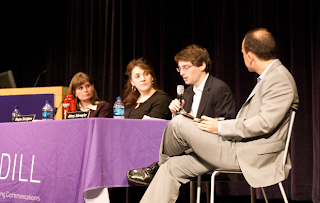
On Monday, Vitamin IMC hosted its first ever social media panel to discuss the essentials and benefits of using social media to connect to a career in communications. Lucky for our audience, we were bestowed with expert advice from some seasoned pros.

We were fortunate to have Blagica Bottigliero, Emmy-winning blogger and member of the Edelman Digital team, Johnny Schroepfer, Medill IMC student, and Gini Dietrich, founder and CEO of Arment Dietrich, share insights and tips on how to use social media tools to build a personal brand and find a killer job.


“What social media has done is completely flatten out the globe,” said Dietrich, referring to the ability to talk to anyone on Twitter, including CEOs and popular industry figures.

A key point in using social media for the job search is that you get out of it what you put into it. Bottigliero advised that job seekers should put twice as much time into their search as they do studying or with other media such as TV or texting.

Job seekers should also be wary of over-spamming new online contacts or being completely self-promotional.

“The last thing they want to know is all about you,” said Schropefer. “Its about communication and interaction. It’s two ways.”

Key Takeaways…

On building a personal brand:

  • Own your own domain name and use your actual name to come up more often in searches.
  • Clean up any online information about you that doesn’t look professional (ahem, Facebook party photos from college). And yes, recruiters actually look for unprofessional antics and flag those applicants.
  • Go to namechk.com. This site allows you to see where your name is registered on any social media site, and where it isn’t. Make sure you own your name on all relevant sites.

On Twitter:

  • Keep interactions relevant. Don’t clog someone’s stream with a surplus of @replies.
  • Drive people to your LinkedIn page or website. Twitter isn’t the ultimate answer to connect with people in your job search.

On Blogging:

  • Write about what you’re passionate about – people find you valuable if you have a niche and offer information generalists can’t.
  • Try not to be negative on your blog; nobody wants to hire someone who complains.

If there’s one thing our audience learned, it was to start the digital conversation now and to make ourselves known to potential employers in an authentic way. Relationships rule. Take the time to research, relate and impress.

As Gini Dietrich told us, “If I receive a resume from someone who has not taken time to connect with my company on social media, I won’t even look at it.”

How’s that for inspiration?

Friday, May 7, 2010

Vitamin IMC Panel: Connecting to Your Career with Social Media

Vitamin IMC is pleased to announce our first panel event on Monday, May 17th at 3 p.m. featuring a number of distinguished speakers and topics to fuel your job search!

The goal of this panel is to give you insight on how to utilize social media networks in connecting with job prospects through building relationships online. You will also hear about how those skills are valuable as a new hire in today’s communications work environment.

What: Vitamin IMC Social Media Panel


When: Monday, May 17th, 3:00 - 4:30 p.m.


Where: McCormick Tribune Center Forum, Medill School of Journalism, Northwestern University 


Moderator:
Dan Gruber, Assistant Professor in the Medill IMC Program & Kellogg School of Management


Panelists:
Gini Dietrich, Founder and CEO of Arment Dietrich and www.SpinSucks.com

Blagica Bottigliero, Emmy-winning blogger and member of the Edelman Digital team

Johnny Schroepfer, Medill IMC student & resident social media specialist

Allan Schoenberg, Director of Corporate Communications for CME Group

Can't wait to see you there!

Monday, May 3, 2010

The Pepsi Refresh Project: Inside the Secret Formula

A Conversation with David Dreyer of TBWA\CHIAT\DAY

In January, Vitamin IMC ran a post about Pepsi’s decision to spend millions on a program called the Pepsi Refresh Project instead of investing in its traditional Super Bowl advertising spots. Little did we know that the concept was developed by a team from TBWA\CHIAT\DAY Los Angeles that included Medill IMC alum David Dreyer. Vitamin IMC Social Media Director Anne Mahoney was fortunate enough to have a conversation with David on the strategy and IMC elements behind the successful project.

On Strategy

“Pepsi wasn’t going to be the first to do philanthropic work or social media, and didn’t want to be a ‘me too’,” said Dreyer.

So how did TBWA\CHIAT\DAY propose capturing the essence of the Pepsi brand in an authentic way that resonated with consumers?

“Pepsi has always been at its best as a catalyst for change. In the Great Depression, it doubled the amount of ounces for the same cost. During World War II, it adopted its patriotic red, white and blue colors. It was always leading culture.”

The Pepsi Refresh Project was an idea formed from consumer insights. The Pepsi Refresh Project gives financial grants to anyone’s causes or ideas that gain the highest number of votes. With enthusiastic support from Pepsi CEO Indra Nooyi and company bottlers, the TBWA\CHIAT\DAY developed its rollout plan to the public.

“It was very deliberate – a marathon and not a sprint,” said Dreyer. “Refresh was launched in 2009 when we talked about it [to the public], and in 2010 we acted on it.”

Grant submissions began online in January 2010, with a cap of 1,000 on a first-come, first-serve basis each month. To give an idea of how popular the Pepsi Refresh Project has become, that 1,000-submission quota was reached in 30 minutes when opened for April.

On Engagement

The Refresh Project gives Pepsi the extra marketing power Super Bowl commercials fall short on – customer engagement. Where companies pay millions for celebrities to endorse their brands, Pepsi now has celebrities coming to them wishing to participate. Rihanna, Jenny McCarthy, Eva Longoria and Mariska Hargitay are just a few who have submitted grant ideas.

A great example of how the Refresh Project has helped its consumers is the case of Johnny Greenshield, a 14-year-old who won $25,000 with his homemade video of a new aerodynamic hood invention for buses.

On Demographics

When I think Pepsi marketing, I think of Gen Y as the ideal target audience. David had an intriguing response to that assumption.

“Pepsi symbolized youth, but some of its most loyal consumers are boomers. It needed an idea that bridged gap between millennials and boomers. Both groups are powerful agents of change, but because of psychographics rather than demographics.”

Do you think that boomers are too far outside of the internet age to participate?

“The majority of ideas are submitted by boomers, and they are the fastest growing demographic on Facebook,” Dreyer continued. “They have time, are computer-savvy, and it’s a way for them to keep in contact with friends and family.”

The Pepsi Refresh Project is an integrated marketing campaign that we’re continuing to keep an eye on. I’d like to give my personal thanks to David Dreyer for sharing his insights with Vitamin IMC.

--Anne Mahoney

***

Anne Mahoney is the Social Media Director of Vitamin IMC and a student in the Masters in Integrated Marketing Communications program at Northwestern University’s Medill School. In the 90s she tried to win Deion Sanders gear through the Pepsi Stuff promotion. She can be reached at AnneMahoney2010@u.northwestern.edu.